
It’s coming. Have you checked your #HVAC system? Are you ready? 
Category Uncategorized
Vote
There is nothing more important than our freedom. Use that freedom to make a difference today. 
Fiberglass vs Pleated Air Filters
Do not fall into the trap of thinking that all furnace filters are the same. Do not run out and buy the cheapest filter that you can find, just to save a few cents. In the long run, purchasing a cheap fiberglass filter can cost you thousands of dollars over the long run. With Nordic Pure’s pleated furnace filters, you may be making a larger initial investment, however you will be able to save thousands of dollars in the long run. To understand how a high quality furnace filters can save you money, it is important to understand the effects of poor filtration.
The Drawbacks of Fiberglass Furnace Filters
- Poor Air Quality
The EPA has indoor air pollution listed as a Top 5 threat to our environmental health. This is because aside from everyday dirt and dust, your home is also full of particulates like: bacteria, mold, pollen, allergens, dander, dust mites, and even fiberglass from your filter. This risk becomes even more prominent once you think about how much time you spend inside. Most people spend an average of 90% of every day inside. This has become a much more prominent issue because the air inside your house is normally 2 to 5 times more polluted than the air outside.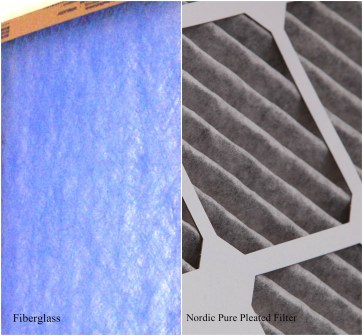
- Monthly Maintenance Expenses
Fiberglass furnace filters must be replaced often. It varies by households from every two weeks to every six to eight weeks. Even though they are a cheap initial investment, it becomes much more expensive than more durable pleated furnace filters over time.
Increasing energy cost furnaces are designed to run with an optimal level of air flow. When a furnace is pushed beyond this range in either direction, it takes much more energy to produce the same results. Fiberglass furnace filters have a tendency to clog extremely fast when compared to a Nordic Pure pleated furnace filter. Fiberglass furnace filters have been reported to increase your monthly heating and cooling costs by as much as 30% when compare to pleated furnace filters.
- Furnace Repair Expenses
Any time you need to repair or replace your furnace, it can become expensive very quickly. Additionally, while it is out of service, your house will likely become very uncomfortable. Fiberglass furnace filters are designed only to filter out the largest of debris. This allows small pieces of dirt and dust to pass directly into your furnace. Once dirt finds its way into your HVAC system, they will disrupt moving parts and even clog the hose connections. This means that you furnace must work much harder to achieve your desired results. The harder it is forced to work, the sooner it breaks down and needs to be repaired or replaced. This is especially true when your furnace is working hard over a long period of time, such as the cold winter months.
Better Air Quality Can Reduce Medical Expenses
Fiberglass furnace filters cannot filter out many particulates like many forms of mold and bacteria. This mold and bacteria will often attach itself to some of the warmer and damper parts inside of the furnace. This gives them the perfect place to grow. Since they are already past your filter, they can break off and pass through home at any time. This can increase your medical expenses, not only by directly making you and your family ill, but it also is the perfect way to agitate someone with asthma.
Decreasing Overall Expenses
Nordic Pure furnace filters can decrease expenses in a number of ways including decreased maintenance/repair/replacement costs for both the furnace and the filter itself. Since a pleated furnace filter can filter out much smaller particulates, this diminishes the ability of dirt and dust to enter your HVAC system. This increases the lifespan of your furnace because it allows it to operate within its optimal range. This means less maintenance is needed, less repair expenses, and a much longer lifespan for the furnace itself.
Another advantage of using a Nordic Pure pleated furnace filters is they are sturdy filters. Fiberglass filters are incredibly fragile because of poor construction and the strength the fiberglass itself. The fiberglass will often break apart as it is bombarded by air. Tiny pieces of fiberglass then flow through the furnace and are dispersed across the house. This can not only aggravate asthma, but can create long term health problems. Nordic Pure pleated furnace filters last much longer than their fiberglass counterparts which means you can replace them less often.
Changing Your Home Air Filter
The quickest and easiest way to maximize the efficiency of your heating and air conditioning system while helping purify your home’s air is by changing your home air filter. It is much easier than you think!
Changing your home air filter should not take more than five or ten minutes. The greatest challenge most homeowners face is finding the appropriate size filter. We have included an article to choosing the proper filter size in “Choosing the Proper AC and Heater Filter Size.”
Once you have the appropriate replacement AC filter or heating system filter, simply go through these 6 simple steps:
1. Turn off your furnace
2. Find and locate your furnace filter
3. Remove the old filter
4. Insert the new filter
5. Turn system on
1. Make Sure to Turn Your AC or Furnace Off Before Changing Your Filter
Make sure you turn the thermostat to the “off” position before attempting to change the ac filter or heater filter. Do this to help protect your HVAC system from loose debris and to prevent the filter from getting sucked into the machine, which could cause damage to your system. Ideally, you should disconnect the power from your AC system or heating system while you are doing maintenance.
2. Find and Locate Your Furnace Filter
Do you know where your AC or heating system filter is located? Here are two suggestions to answer this question.
Begin by locating your operations manual for your AC and/or heating system. If you cannot locate it, you might want to try to locate it online.
Begin by obtaining the manufacturer’s name and model number from the ID plate on the heating and/or air conditioning unit. Then go to the internet and type in the description of the unit. You may find the operations manual online, either through the manufacturer or a distributor of the manufacturer’s products. This manual should tell you what size filter is recommended for your heating and cooling system.
If you don’t have your unit’s operations manual, locate the air filter(s) which can be found in either the blower compartment of the furnace (remove the furnace cover, typically by lifting up), or built into the system before the blower fan.
3. Remove the Existing Air Filter
You will want to install the new filter in the same direction as the old one. Before you remove the existing air filter, note the arrow on the filter frame that shows the correct air flow direction. The “air-flow direction arrow” should point towards your furnace.
It’s a good idea to place a sticker in a prominent place showing the airflow direction arrow and the AC or heating system filter size (i.e.: 20x25x5 Airflow→)
Take out a garbage bag and pull the old filter out, placing it directly into the garbage bag to avoid any mess.
4. Insert the New Air Filter
Begin installing the new filter by writing the install date on the filter. Nordic Pure filters have a place already marked for you to put the date.
And DO NOT forget to note the direction of the arrow on the old filter frame to insure the correct air flow direction. Remove the old filter and insert the new one so that the airflow direction remains the same.
HVAC filters are designed to filter air from one direction so as dust and dirt accumulates, the filter will not collapse or fall apart. Nordic Pure filters have a screen wire support system to insure our filters remain intact throughout the life of the filter.
5. Turn System On
The last step in replacing your ac or furnace filter is to turn the system back on. This may include turning the entire system’s power back on or simply the thermostat depending upon how you shut the system off.
You are now ready to use your furnace again! PLEASE make sure you included the install date for the new filter on the actual filter itself for easy reference.
Once your new filter is installed, be aware of the importance of routinely changing out your AC or HVAC filter on a regular basis to enjoy the cleanest air and to protect your expensive HVAC system.
Nordic Pure offers a free reminder service to make it simple to be reminded it is time to change your filter.
The Importance of Air Filters
Check out this awesome info-graphic from Steam Express out of Houston! This provides a guide into why air filters are so important and the things in your home that are trying to destroy your clean air!

Enjoy Your Morning Brew

Is Your AC Filter Stealing Money and Comfort From You?
When is the last time you changed your ac or furnace filter? Chances are, unless you are pretty diligent, you likely forget to change your ac or furnace filter as often as you should.
We recommend changing your AC or furnace filter at least every 90 days, or if you or anyone in your family has health issues, allergies to dust mites and pollen or other irritants. To make it really easy to remember when to change your filters, you can use Nordic’s free reminder service so you never forget, ask one of our customer service associates when you order next!
AC and furnace filters work by trapping particulates that are suspended in your indoor air in the filter material, a sheet of polyester fabric that is woven for strength and performance.
As air flows through the system, particulates are trapped in the fabric of the filter. As particulates build up over time, they residually “plug” the filter. The resulting reduction in air flow forces the HVAC system to work harder to push the same amount of air through the system. This results in increased operating costs. Further, as the filter gets “plugged” with contaminants, the ability to purify the air that is flowing through the system is diminished.
An even better way of keeping up with the filter in your HVAC System is to install an Air Gauge that tells you the condition of your filter.
 Our preferred system is the General Air Gauge. The G-99 Air Filter Gage provides a visual indication of the need to replace the air filters in forced air heating and cooling systems thereby eliminating any guesswork about the condition of your ac or furnace filter. The gage is installed between the blower and the filter where a slight vacuum exists due to the air flow resistance of the air filter. Air flowing into the gage, around the calibration screw, lifts a vane in proportion to the negative pressure in the blower compartment. As the air filter loads, the vacuum increases, raising the vane to indicate a filter change is necessary.
The gage may be calibrated in a negative pressure range from 0.1 to 0.4 inch w.c. When properly calibrated in this range a vacuum increase of 0.10 to 0.15 inch w.c. will indicate a filter change is necessary.
If you are looking for the perfect solution to maintaining optimum efficiency of your heating and/or cooling system, please consider the GeneralAire Air Gauge.
Naturally Fresh
For those not so cute odors try our naturally fresh Pure Baking Soda filter. Made with unscented baking soda, this filter will deodorize your home while collecting pet dander, allergens and dust! Leaving your air clean and fresh! Oh and it’s Grandma Approved! 
Together, we can make a difference in th
Together, we can make a difference in the lives of women, families, and communities touched by ovarian cancer. #knowovarian #nocc #cancersucks http://ow.ly/i/n3Sli
 Nordic Pure ®
You must be logged in to post a comment.